Hair transplant is a surgery performed to restore hair to areas of the scalp that are bald or that have thinning hair. The healthy hair of the patient himself/herself is implanted to the areas of hair loss. The region where the hair is taken is called Donor Area (generally is the back of the head), it doesn’t lose hair as quickly as in the front and it is programmed genetically to resist to the hormones that causes hair loss.
What is Hair Transplant surgery? Hair transplant is a surgery performed to restore hair to areas of the scalp that are bald or that have thinning hair. The healthy hair of the patient himself/herself is implanted to the areas of hair loss. The region where the hair is taken is called Donor Area (generally is the back of the head) , it doesn’t lose hair as quiquly as in the front ans it is programmed geneticaly to resist to the hormones that causes hair loss.
What causes hair loss? Baldness is often blamed on poor circulation to the scalp, vitamin deficiencies, dandruff and even excessive hat wearing. All of these theories have been disproved. It's also untrue that hair loss can be determined by looking at your maternal grandfather, or that 40-year-old men who haven't lost their hair will never lose it. Hair loss is primarily caused by a combination of: • Aging • A change in hormones • A family history of baldness As a rule, the earlier hair loss begins, the more severe the baldness will become.
What can a Hair Transplant do ? Hair transplantation involves removing small pieces of hair-bearing scalp from a donor site and using them as grafts to be relocated to a bald or thinning area of the scalp. A Hair Transplant procedure can: • Restore hair growth • Improve Appearance • Provide higher density • Build confidence, regain self-esteem
Hair Transplant Process Before going to the operation your surgeon need to examine your case. You will be asked to send pictures from different angles to see your bold and donor areas. Based on that the doctor will explain how the transplant can be done , how many grafts you need and how many can be extracted. Before starting a transplant, the team will start shaving your hair fully or just the back of your scalp. Your surgeon then sterilizes the area where the hair will be removed and numbs it with a local anesthetic. You can also request sedation in order to stay asleep for the procedure.
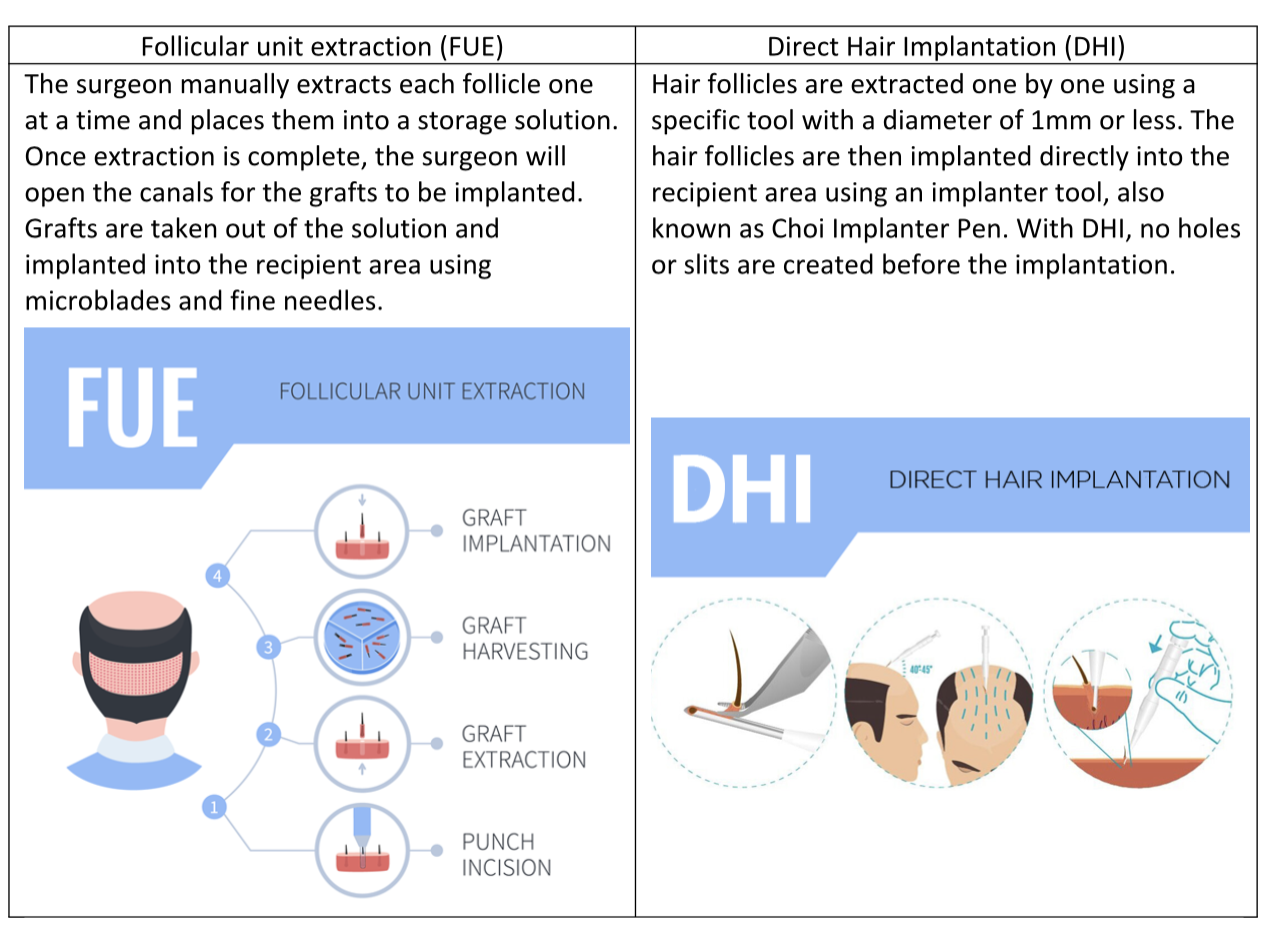
It exist two transplant methods: FUE or DHI
Title of the block After the bandages are removed a day later, patient can wash his hair gently with a special shampoo. Stitches will be removed around 10 days later. Intense exercises and contact sports have to be avoided for three weeks.
Can everyone have a Hair Transplant ? You may be a candidate for hair transplant surgery if you have healthy hair growth at the back and sides of the head to serve as donor areas. There is no hard set limit as to the age of a hair transplant candidate, however, surgeons are most careful in dealing with patients under 18. Since the pattern that the hair loss is evolving into is yet to be determined, surgeons would prefer that they be fully mature.
Instructions for better Hair Transplant The following instructions are general information to be followed before and after a Hair Transplant procedure:
· 10 days prior to surgery : No aspirin, Advil, Motrin, vitamins, vitamin E (in particular), steroids, cortisone creams, green tea, or smoking!
· Don’t drink alcohol 48 hours before the surgery
· Don't cut your hair before the transplant procedure, because we will do it in the hospital right before the operation. Hair shaving helps to evaluate the hair bank better and to determine the number of follicles that can be extracted from the donor area; it also helps to extract the follicles properly and adjust the angle of extraction, which is crucial for the success of the operation.
· When you come to the operation, please wear comfortable clothes, and a cosy shirt with buttons or a sweater with zipper. This will be important while getting dressed and undressed
· You should have a full rest the day before the operation, and sleep very well.
· After surgery go home and rest. Keep your head up about 45 degrees, a recliner is great. An airplane pillow is awesome at keeping you from rolling over and pulling out our new hair today.
· No ice, no towels, no sprays, no hats, no bandanas, and no touching your recipient area.
· Start your antibiotics when you get home, and take your pain pills as directed on the bottle.
· On day 2, take a plastic cup in the shower with you, fill it with water, and pour it over your recipient area a bunch of times. It’s ok if shower water gets on the new hair but don’t towel off and don’t get soap in your eyes and then wipe across the new hair yet.
· Days 3 to 7: Wash your recipient area twice a day, conditioner first for 15 minutes or so, then rinse it out and shampoo gently….a bit harder every day. We’re trying to get rid of crust.
· Don’t wear any hat on your head until your sutures are out.
· Don’t spend a lot of money on supplements or things you might hear to make your hair grow. Be patient.
· Don’t bang your head around.
· Don’t panic about the numbness. It is normal for it to take 4 months to start to resolve.
· Don’t get your answers from the internet. Get them from us.
Average Length of Stay 2 Days
Length of Stay in Hospital No Need
Operation Duration 8 Hours
Anesthesia Local Anesthesia
Recovery Duration 7-10 Days
What are the risks of hair transplant?
All surgery carries some degree of risk. Some of the possible complications of hair transplant surgery include:
risks of general anaesthesia, including allergic reaction, which may (rarely) be fatal surgical risks such as bleeding or infection scars that may be severe, raised, reddened and itchy nerve damage, including permanent loss of sensation death of the skin grafts tissue death along the wound further surgery to treat complications.
This is not a complete list. For example, your medical history or lifestyle may put you at increased risk of certain complications. Speak to your surgeon for more information.
How long does hair transplant last?
The good news is that when performed by a trained, experienced hair restoration specialist, a hair transplant procedure can last a lifetime.That’s because the genetic predisposition for hair loss resides in the follicle, rather than in the scalp.
How painful is a hair transplant?
A hair transplant is usually carried out under local anaesthetic and sedation, which means you’ll be awake but will not feel any pain.
Do hair transplants look natural?
Hair transplants can look completely natural — as long as you go to the right surgeon. Hair transplant candidates may be concerned about the conspicuousness of their results, but with a talented and qualified surgeon, “Your scalp will not look like a doll’s head’’
Does hair transplant leave scars?
FUE hair transplant surgery does leave scars at the back and sides of your head. These scars occur in the donor area of your scalp- the area where hair follicles have been taken out. It is important to realise that a well performed FUE hair transplant DOES NOT leave noticeable scars
Can you tell if someone has a hair transplant?
Hair transplantation has advanced to the point where it is difficult to tell if someone has undergone surgery or not. The results are very natural looking and will be indistinguishable from your remaining hair.
Can chest hair be used for hair transplant?
Body hair transplantation using scalp hairs is a procedure designed to restore hair most commonly to the chest and abdomen area, but can also be applied to the pubic area, axilla, arms, and any other area hair is desired, to both thicken the existing hair or to provide hair growth where there is none
Can facial hair be transplanted to the head?
Using the beard as donor hair helps the surgeon preserve donor hair on the traditional scalp safe zone for more critical areas such as frontal hairline, temporal points and eyebrows. Thicker hair shaft – Beard hair is usually much thicker than scalp hair which helps with creating more volume in transplanted areas
Can you shave your head after a hair transplant?
Yes, it is possible to shave your head after an FUE hair transplant, and we recommend waiting for 8-10 days before doing so. However, one shouldn’t wet shave the treated areas for at least 3 months after surgery.
How can I take care of my hair after the surgery?
Be guided by your surgeon. General self-care suggestions include:
Follow all instructions on looking after your wounds. Avoid exercise or any strenuous activity that could increase blood pressure, as this can make your wounds bleed. Your surgeon may advise you to avoid sex for about 10 days. Report any bleeding, severe pain or unusual symptoms to your surgeon.
When can you wear hat after hair transplant?
To avoid damaging the fragile new hair grafts we recommend that you wait until six days after your hair transplant before wearing a hat.
What is Hair Transplant surgery?
Hair transplant is a surgery performed to restore hair to areas of the scalp that are bald or that have thinning hair. The healthy hair of the patient himself/herself is implanted to the areas of hair loss. The region where the hair is taken is called Donor Area (generally is the back of the head) , it doesn’t lose hair as quiquly as in the front ans it is programmed geneticaly to resist to the hormones that causes hair loss.
What causes hair loss?
Baldness is often blamed on poor circulation to the scalp, vitamin deficiencies, dandruff and even excessive hat wearing. All of these theories have been disproved. It's also untrue that hair loss can be determined by looking at your maternal grandfather, or that 40-year-old men who haven't lost their hair will never lose it. Hair loss is primarily caused by a combination of: • Aging • A change in hormones • A family history of baldness As a rule, the earlier hair loss begins, the more severe the baldness will become.
What can a Hair Transplant do ?
Hair transplantation involves removing small pieces of hair-bearing scalp from a donor site and using them as grafts to be relocated to a bald or thinning area of the scalp. A Hair Transplant procedure can: • Restore hair growth • Improve Appearance • Provide higher density • Build confidence, regain self-esteem
Hair Transplant Process
Before going to the operation your surgeon need to examine your case. You will be asked to send pictures from different angles to see your bold and donor areas. Based on that the doctor will explain how the transplant can be done , how many grafts you need and how many can be extracted. Before starting a transplant, the team will start shaving your hair fully or just the back of your scalp. Your surgeon then sterilizes the area where the hair will be removed and numbs it with a local anesthetic. You can also request sedation in order to stay asleep for the procedure. It exist two transplant methods: FUE or DHI
After the bandages are removed a day later, patient can wash his hair gently with a special shampoo. Stitches will be removed around 10 days later. Intense exercises and contact sports have to be avoided for three weeks.
Can everyone have a Hair Transplant ?
You may be a candidate for hair transplant surgery if you have healthy hair growth at the back and sides of the head to serve as donor areas. There is no hard set limit as to the age of a hair transplant candidate, however, surgeons are most careful in dealing with patients under 18. Since the pattern that the hair loss is evolving into is yet to be determined, surgeons would prefer that they be fully mature.
Instructions for better Hair Transplant
The following instructions are general information to be followed before and after a Hair Transplant procedure:
Pre-Operation: · 10 days prior to surgery : No aspirin, Advil, Motrin, vitamins, vitamin E (in particular), steroids, cortisone creams, green tea, or smoking! · Don’t drink alcohol 48 hours before the surgery · Don't cut your hair before the transplant procedure, because we will do it in the hospital right before the operation. Hair shaving helps to evaluate the hair bank better and to determine the number of follicles that can be extracted from the donor area; it also helps to extract the follicles properly and adjust the angle of extraction, which is crucial for the success of the operation. · When you come to the operation, please wear comfortable clothes, and a cosy shirt with buttons or a sweater with zipper. This will be important while getting dressed and undressed · You should have a full rest the day before the operation, and sleep very well. Post-Operation: · After surgery go home and rest. Keep your head up about 45 degrees, a recliner is great. An airplane pillow is awesome at keeping you from rolling over and pulling out our new hair today. · No ice, no towels, no sprays, no hats, no bandanas, and no touching your recipient area. · Start your antibiotics when you get home, and take your pain pills as directed on the bottle. · On day 2, take a plastic cup in the shower with you, fill it with water, and pour it over your recipient area a bunch of times. It’s ok if shower water gets on the new hair but don’t towel off and don’t get soap in your eyes and then wipe across the new hair yet. · Days 3 to 7: Wash your recipient area twice a day, conditioner first for 15 minutes or so, then rinse it out and shampoo gently….a bit harder every day. We’re trying to get rid of crust. · Don’t wear any hat on your head until your sutures are out. · Don’t spend a lot of money on supplements or things you might hear to make your hair grow. Be patient. · Don’t bang your head around. · Don’t panic about the numbness. It is normal for it to take 4 months to start to resolve. · Don’t get your answers from the internet. Get them from us. Average Length of Stay 2 Days Length of Stay in Hospital No Need Operation Duration 8 Hours Anesthesia Local Anesthesia Recovery Duration 7-10 Days